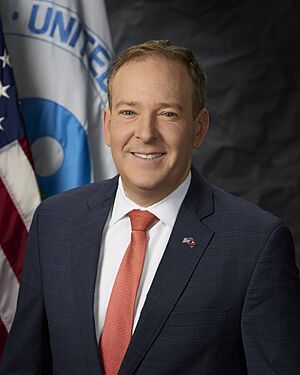
Lee Michael Zeldin is a Long Island Republican serving as the 17th Administrator of the Environmental Protection Agency since January 29, 2025. His pitch is not climate-activist moralism. It is “stability and enforcement”: protect air and water without using the EPA as a weapon to offshore industry, spike household energy costs, or choke permitting into paralysis.
Zeldin’s governing argument is that environmental policy is inseparable from energy security. He frames heavy-handed regulation as a middle-class tax that flows into utility bills, rent, groceries, and manufacturing employment. In practice, that worldview pushes him toward permitting acceleration, narrowing rules he calls “blanket” restrictions, and re-centering EPA on visible, local harms like toxic sites, drinking-water safety, and industrial runoff rather than climate-first frameworks.
His political identity was forged in Trump-era combat. A close Trump ally, Zeldin became a prominent defender during the first impeachment and later aligned with election-fraud litigation efforts after 2020. Before EPA, he represented New York’s 1st Congressional District from 2015 to 2023 and served in the New York State Senate from 2011 to 2014 (3rd District). He was also the 2022 Republican nominee for Governor of New York, losing to Kathy Hochul but posting the strongest GOP statewide performance in years by raw vote total and share.
Zeldin’s tenure at EPA is defined by deregulation as a strategy, not a side effect. He has moved aggressively against Biden-era rules aimed at power-plant emissions, waterway pollution, and chemical restrictions, and he has pursued structural downsizing moves inside the agency itself. Supporters see “course correction” and regulatory realism. Critics see a deliberate rollback of public-health guardrails and a tilt toward fossil fuel producers and heavy industry.
Personally, Zeldin’s profile is also shaped by military service and law: he received an Army ROTC commission, served on active duty in the U.S. Army from 2003 to 2007 (including a deployment to Iraq in 2006), then continued in the Army Reserve, reaching lieutenant colonel before retiring in 2025. He earned a BA in political science from SUNY Albany (2001) and a JD from Albany Law School (2003), and he was admitted to the New York bar in 2004 (notably young at the time).
Mainstream Conservative
Achievements
- Reframed EPA messaging toward “public health basics” (air, water, toxics) paired with “energy realism,” making regulation a cost-of-living argument rather than a morality play.
- Moved quickly to unwind major Biden-era regulatory architecture, prioritizing permitting acceleration and narrower rule scope.
- Leveraged his Long Island record on water and coastal issues to claim a conservation lane while still opposing “punish-first” climate policy.
- Built a national profile as a disciplined Trump-aligned operator who can run high-conflict hearings and survive sustained media pressure.
- Positioned domestic production standards as a substitute for global-symbolic climate commitments that he argues lack enforcement.
Controversies
- Critics argue his approach guts core legal foundations for greenhouse-gas regulation and weakens protections for wetlands, tailpipes, smokestacks, and chemical exposure.
- Downsizing moves (including proposed deep budget cuts and elimination of research capacity) raise concerns about enforcement and scientific integrity.
- Opponents argue that carve-outs for power plants and industrial actors invite regulatory arbitrage and uneven public-health outcomes.
- Streamlined permitting is framed as growth, but EJ advocates warn it concentrates burden in communities already overexposed to pollution.
- Democrats and climate groups see him as a Trump loyalist executing a pre-set rollback agenda rather than an independent regulator.
Senate Confirmation Vote
Votes For
Votes Against