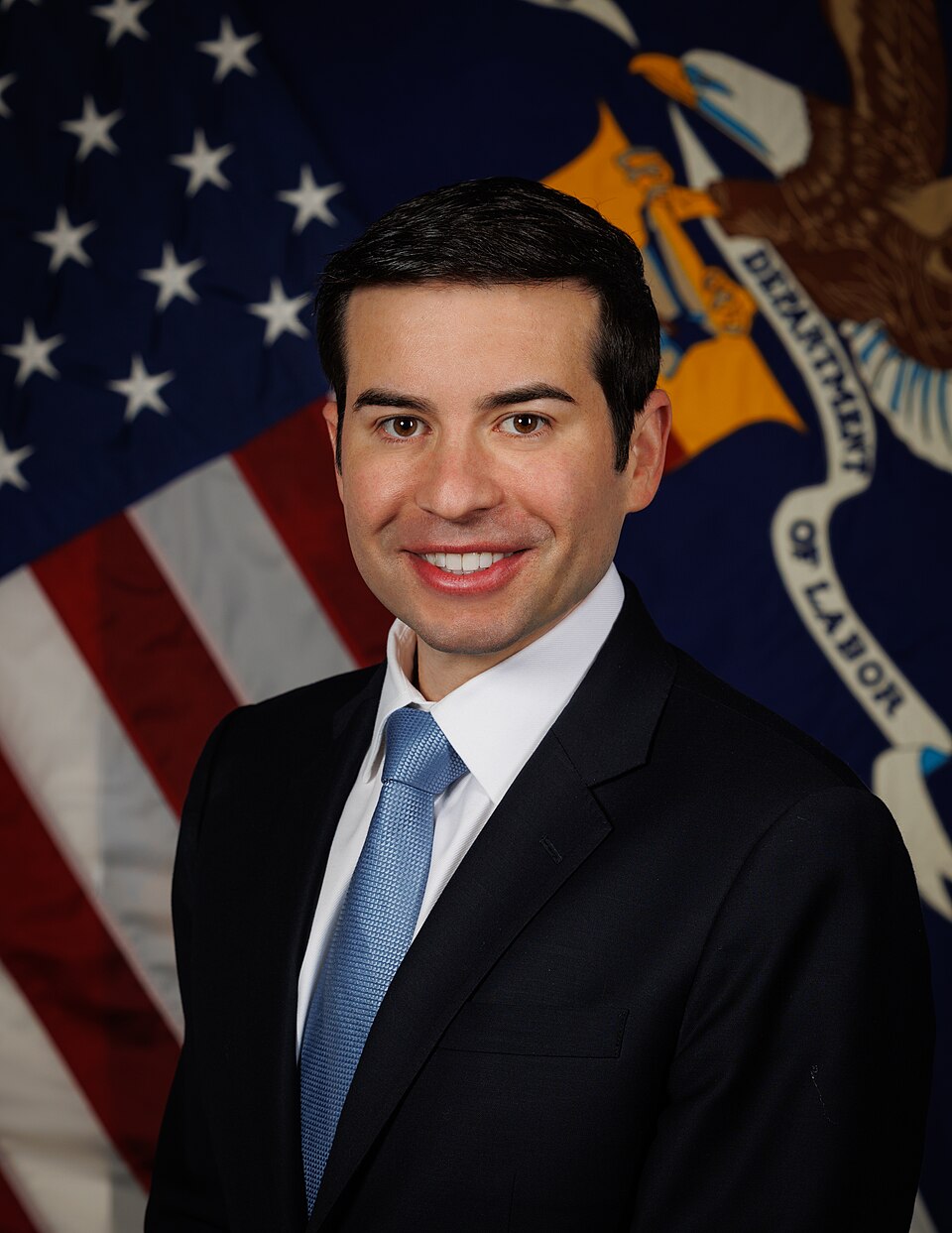
Keith Elliot Sonderling is an American lawyer and government official born on November 25, 1982, in Manhattan, New York City, and raised in Boca Raton, Florida. The grandson of Holocaust survivors, he is Jewish and graduated from Spanish River High School. He earned a bachelor's degree magna cum laude in broadcast journalism from the University of Florida and a Juris Doctor magna cum laude from Nova Southeastern University. He began his legal career at the West Palm Beach firm Gunster, Yoakley and Stewart, where he practiced labor and employment law and was elevated to shareholder in 2015. In 2012, Governor Rick Scott appointed him to the 4th District Court of Appeals judicial nominating commission, and his fellow commissioners elected him chair in 2016.
Sonderling joined the Department of Labor's Wage and Hour Division in September 2017 and served as its acting administrator in 2019, during which time he issued the department's first opinion letter on the gig economy, concluding that gig workers were independent contractors rather than employees under the Fair Labor Standards Act, and developed the Payroll Audit Independent Determination program, the agency's first comprehensive self-audit initiative, which recovered $7 million in wages for 11,000 workers. President Trump nominated him to the Equal Employment Opportunity Commission in 2019 and the Senate confirmed him 52 to 41 in September 2020. During his four-year EEOC tenure through August 2024, he focused on ensuring that artificial intelligence-based employment technologies complied with anti-discrimination law and served as an adjunct professor at the George Washington University Law School teaching employment discrimination.
Trump nominated Sonderling as Deputy Secretary of Labor in January 2025 and the Senate confirmed him 53 to 46 on March 12. On March 18, Trump simultaneously designated him Acting Director of the Institute of Museum and Library Services and Acting Under Secretary of Commerce for Minority Business Development. On April 20, 2026, White House communications director Steven Cheung announced that Secretary of Labor Lori Chavez-DeRemer was resigning to take a job in the private sector, and Sonderling became the acting Secretary of Labor. Her departure followed a months-long Office of Inspector General inquiry into allegations of misconduct in her department.
Context: Predecessor's Resignation
Lori Chavez-DeRemer's resignation on April 20, 2026, followed a sprawling misconduct investigation that had consumed her department for months. In December 2025, the Labor OIG received a complaint alleging that two senior aides, Jihun Han and Rebecca Wright, had facilitated personal travel for Chavez-DeRemer by announcing fake official events. The complaint also alleged that she had an affair with a member of her security detail, Brian Sloan, and openly drank on the job with her aides' knowledge. In January 2026, the Metropolitan Police Department filed a report about forced sexual contact at the Labor Department's building, believed to be connected to allegations that Chavez-DeRemer's husband Shawn DeRemer had inappropriately touched two women, and he was subsequently banned from entering the building in February. The New York Times reported that over two dozen current and former employees described a toxic workplace worsened by Chavez-DeRemer's frequent absences, combative aides, and demoralized staff. Han and Wright were fired in March 2026, followed by the firing of her director of advance and the resignation of Sloan. Trump reportedly expressed frustration with Chavez-DeRemer in the weeks before her departure, and the inquiry later expanded to include personal requests she texted to aides. She was additionally the subject of three separate civil rights complaints from women before her April 20 resignation.
Mainstream Conservative
Achievements
- Confirmed as Deputy Secretary of Labor 53 to 46 in March 2025 after a career spanning private labor and employment law, two separate DOL appointments, and four years as an EEOC commissioner, bringing deeper subject-matter expertise to a Cabinet-level department than most political appointees in the second Trump administration.
- As acting administrator of the Wage and Hour Division in 2019, issued the first federal opinion letter on the gig economy classifying gig workers as independent contractors under the Fair Labor Standards Act, a determination that reshaped the legal landscape for platform economy companies, and developed the Payroll Audit Independent Determination program, which recovered $7 million in back wages for 11,000 workers through voluntary employer compliance.
- Served as a pioneering voice within federal government on the intersection of artificial intelligence and employment discrimination law during his EEOC tenure, publishing widely and speaking globally on how AI-driven hiring and workforce management tools intersect with existing anti-discrimination statutes, positioning himself as one of the first senior government officials to systematically address the civil rights dimensions of algorithmic employment decisions.
- Simultaneously holds three Senate-confirmed or acting-designated positions spanning labor, cultural institutions, and minority business development, a breadth of concurrent responsibility unusual even by the standards of the consolidation-minded second Trump administration, reflecting his reputation within the White House as a reliable executor of administration priorities across disparate agency portfolios.
Controversies
- Sonderling's 2019 gig economy opinion letter classifying platform workers as independent contractors rather than employees was withdrawn by the Biden administration in 2021 as contrary to worker protection principles, and reinstated in May 2025 after Sonderling became Deputy Secretary. Labor advocates argued the reinstatement of the letter denied wage and benefit protections to millions of gig workers and reflected a structural tilt in the department's enforcement posture toward platform economy employers.
- Sonderling became Acting Secretary of Labor as the direct beneficiary of the misconduct investigation that forced Chavez-DeRemer's resignation, inheriting a department described by dozens of current and former employees as having a toxic workplace culture marked by demoralization and mismanagement. Critics argued that the administration's handling of the Chavez-DeRemer situation, including lengthy delays before any accountability, reflected broader dysfunction in its Cabinet-level personnel management.
- His statement upon being designated Acting Director of the Institute of Museum and Library Services that he would "revitalize IMLS and restore focus on patriotism" drew criticism from library and museum professionals who argued that framing federal cultural funding through a patriotism lens risked politicizing institutions that depend on public trust and intellectual independence, and signaled possible ideological conditions on grant making that would chill the work of recipients.
- Sonderling holds three concurrent acting or designated positions simultaneously with his confirmed Deputy Secretary role, a concentration of authority that administrative law scholars and Democratic senators argued exceeded the normal scope of acting appointments and raised questions about circumventing Senate confirmation for positions requiring distinct expertise and independent accountability.
Top Donors
No donor information available. Keith Sonderling is an appointed official and has not run for elected office.
The organizations themselves cannot donate; totals reflect contributions from individuals and PACs affiliated with each entity.