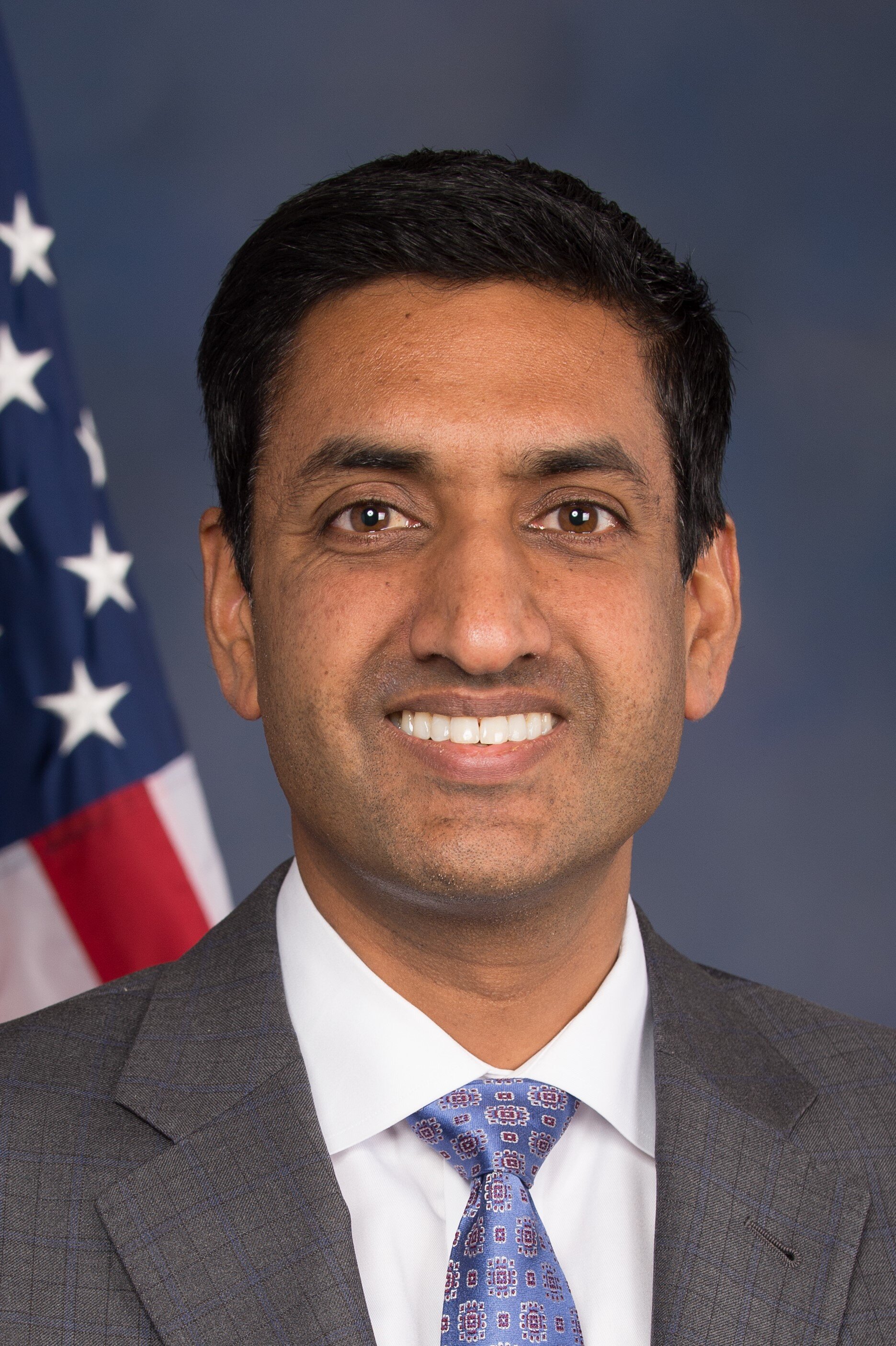
Rohit "Ro" Khanna is an American politician and attorney serving as the U.S. Representative for California's 17th Congressional District since January 2017, representing Silicon Valley communities including Fremont, Sunnyvale, Cupertino, and Santa Clara. Born on September 13, 1976, in Philadelphia to parents who immigrated from Punjab, India, Khanna was raised in Bucks County, Pennsylvania, graduating from Council Rock High School in 1994 before earning a Bachelor of Arts in Economics with honors from the University of Chicago in 1998 and a Juris Doctor from Yale Law School in 2001.
After law school, Khanna clerked for federal appeals judge Morris S. Arnold in Little Rock, Arkansas, and entered private practice specializing in intellectual property law. President Barack Obama appointed him Deputy Assistant Secretary of Commerce in 2009, a role in which he led international trade missions and worked to expand U.S. exports until 2011. He subsequently joined Wilson Sonsini Goodrich and Rosati and served as a visiting lecturer of economics at Stanford University from 2012 to 2016. In 2012 he published Entrepreneurial Nation: Why Manufacturing is Still Key to America's Future. He ran unsuccessfully for California's 17th district in 2014 before defeating eight-term incumbent Mike Honda in 2016.
In Congress, Khanna has focused on technology policy, industrial strategy, competition law, and workforce development. He co-authored the Endless Frontier Act with Senate Majority Leader Chuck Schumer and Senator Todd Young, which formed the basis for the CHIPS and Science Act signed by President Biden in 2022. He co-founded the NO PAC Caucus in 2017 with Beto O'Rourke and Jared Polis, and founded and co-chairs the Congressional Antitrust Caucus. He co-chaired Bernie Sanders's 2020 presidential campaign. He describes his governing philosophy as "new economic patriotism," combining pro-innovation industrial policy with labor protections and expanded social programs.
On foreign policy, Khanna has consistently advocated for a restraint-oriented posture and greater congressional oversight of military engagements. He presided over the 2021 Big Oil hearing as chair of the House Oversight Subcommittee on the Environment, compelling the CEOs of ExxonMobil, Chevron, Shell, and BP to testify under oath about climate disinformation. In 2025 and 2026, his town halls in Republican districts and appearances in early-voting states led national outlets to describe him as a potential 2028 Democratic presidential contender.
Progressive
Committee Assignments
Caucus Memberships
Achievements
- Co-authored the Endless Frontier Act with Senate Majority Leader Chuck Schumer and Senator Todd Young, which formed the legislative basis for the CHIPS and Science Act signed into law in 2022, representing one of the largest federal investments in semiconductor manufacturing and scientific research in American history and a centerpiece of the Biden administration's industrial policy agenda.
- Presided over the October 2021 Big Oil hearing as chair of the House Oversight Subcommittee on the Environment, compelling the CEOs of ExxonMobil, Chevron, Shell, and BP to testify under oath for the first time about their corporations' role in spreading disinformation about climate change, an oversight effort he followed with a two-year investigation that uncovered internal documents contradicting industry public statements on climate commitments.
- Co-founded the NO PAC Caucus in 2017 and has declined PAC contributions throughout his congressional career, while introducing legislation to ban PAC contributions to members of Congress and proposing a "Democracy Dollars" small-dollar matching system with constitutional scholar Bruce Ackerman and former Senator Russ Feingold, establishing himself as one of the House's most consistent advocates for campaign finance reform.
- Played a key role in year-long negotiations with Senator Joe Manchin to secure the $369 billion climate investment in the Inflation Reduction Act and helped bring House progressives and environmental groups on board, contributing to what became the largest federal climate investment in American history.
- Emerged as a nationally prominent progressive figure by 2025 and 2026 through town halls in Republican-held districts and appearances in early-voting presidential primary states, with multiple national outlets identifying him as a leading potential contender for the 2028 Democratic presidential nomination, reflecting a sustained effort to build a cross-regional political coalition rooted in his "new economic patriotism" framework.
Controversies
- Khanna's dual posture on oil production drew criticism for apparent inconsistency: he publicly criticized oil executives for increasing production in October 2021 during the Big Oil hearing, then called for increased production in March 2022 when gas prices rose, a reversal that critics characterized as politically reactive rather than principled on energy policy.
- In February 2026, Khanna read six names from the floor of the House that he said had been redacted from the publicly released Epstein files, including Leslie Wexner and Sultan Ahmed bin Sulayem. The Department of Justice subsequently stated that four of the individuals named had no apparent connection to Epstein and appeared in the files as part of a photo lineup, raising questions about the evidentiary basis for the floor disclosure and whether it unfairly implicated individuals without criminal nexus to the investigation.
- His extensive tech industry donor base, anchored by Google, Apple, Stanford University, and Andreessen Horowitz, has drawn persistent scrutiny given his advocacy for stricter antitrust enforcement of dominant technology firms, with critics arguing that the financial relationships with the very companies subject to oversight create structural conflicts of interest regardless of his stated policy positions.
- Khanna's restraint-oriented foreign policy positions, including co-sponsoring bipartisan War Powers Resolutions requiring congressional authorization for U.S. hostilities with Iran and supporting withdrawal from Syria and Afghanistan, have drawn sustained pushback from interventionist members of both parties and from national security establishment figures who argue his posture underestimates the deterrence value of executive flexibility in crisis situations.
Top Donors
| # | Donor | Total |
|---|---|---|
| 1 | Google Inc | $185,752 |
| 2 | Apple Inc | $59,556 |
| 3 | Stanford University | $50,254 |
| 4 | JStreetPAC | $46,950 |
| 5 | Andreessen Horowitz | $40,600 |
Khanna's donor profile is dominated almost entirely by individual contributions from technology sector employees and investors rather than PAC money, consistent with his NO PAC pledge and his district's identity as the geographic heart of the American technology industry. Google employees represent his single largest source by a wide margin, followed by Apple, Stanford University, and the venture capital firm Andreessen Horowitz. JStreetPAC, the pro-Israel but two-state-solution advocacy organization, is his only traditional PAC in the top five, reflecting his position on the Israeli Palestinian conflict as distinct from mainstream AIPAC-aligned Democrats. The absence of pharmaceutical, defense, or financial sector donors in his top ranks is notable given his committee assignments and distinguishes his fundraising profile sharply from many of his California colleagues.
Recent Elections
2018 General Election (CA-17)
Won D +47.9%| Candidate | Results | |
|---|---|---|
| Votes | % | |
| [D]Ro Khanna (incumbent)✓ Winner | 159,105 | 75.4% |
| [R]Ron Cohen | 52,057 | 24.6% |
Khanna won his first reelection by nearly 48 points against Republican Ron Cohen, improving substantially on his 2016 margin and consolidating his hold on a Silicon Valley district anchored by Fremont, Sunnyvale, and Santa Clara. The result confirmed the district's deep Democratic lean in a midterm environment that was broadly favorable to House Democrats nationally.
2020 General Election (CA-17)
Won D +42.7%| Candidate | Results | |
|---|---|---|
| Votes | % | |
| [D]Ro Khanna (incumbent)✓ Winner | 212,137 | 71.4% |
| [R]Ritesh Tandon | 85,199 | 28.6% |
Khanna won his third term by over 42 points in a presidential year, defeating Republican Ritesh Tandon. Khanna had co-chaired Bernie Sanders's 2020 presidential campaign while simultaneously running for reelection, a dual role that underscored his national profile within progressive Democratic politics. The district's high concentration of technology and semiconductor industry employment continued to define its political character.
2022 General Election (CA-17)
Won D +41.9%| Candidate | Results | |
|---|---|---|
| Votes | % | |
| [D]Ro Khanna (incumbent)✓ Winner | 127,853 | 70.9% |
| [R]Ritesh Tandon | 52,400 | 29.1% |
Khanna won his fourth term by nearly 42 points against Ritesh Tandon, who challenged him for the second consecutive cycle. The district was renumbered from the 17th following redistricting, though its geographic core remained centered on the Santa Clara County communities of Fremont, Sunnyvale, Cupertino, and Milpitas. Khanna's margin remained largely consistent with prior cycles despite a midterm environment that produced mixed results for Democrats nationally.
2024 General Election (CA-17)
Won D +35.3%| Candidate | Results | |
|---|---|---|
| Votes | % | |
| [D]Ro Khanna (incumbent)✓ Winner | 172,462 | 67.7% |
| [R]Anita Chen | 82,415 | 32.3% |
Khanna won his fifth term by over 35 points against Republican Anita Chen in a presidential year, a somewhat narrower margin than prior cycles reflecting modest Republican improvement in parts of Silicon Valley. His growing national profile, including town halls in Republican districts and early appearances in 2028 presidential primary states, defined much of his public posture during the cycle. The result left him among the most prominent progressive voices in the House heading into the 119th Congress.
CA-17 covers Silicon Valley communities in Santa Clara County including Fremont, Sunnyvale, Cupertino, Milpitas, and Santa Clara, as well as portions of Alameda County. The district is among the most technologically concentrated constituencies in the country, home to the headquarters or major campuses of Apple, Google, Intel, and numerous semiconductor and biotechnology firms. Khanna has held the seat since 2017 and has won each general election by at least 35 points, reflecting the district's consistent and substantial Democratic lean in both midterm and presidential years.