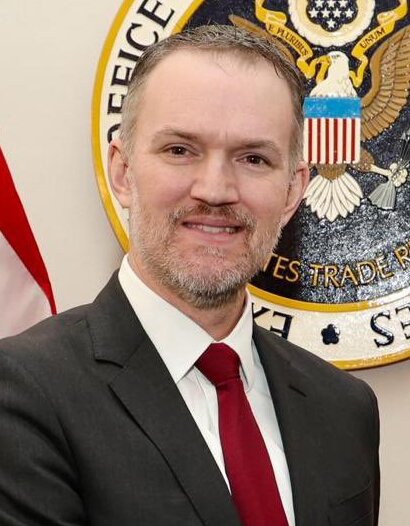
Jamieson Greer is an institutional trade hawk with a lawyer’s brain and a soldier’s instincts about leverage. He is not a nostalgic free trade Republican and he is not a chaos tariff maximalist either. Greer sits in a technocratic America first posture: write the rules tightly, enforce them aggressively, and treat market access as the most valuable pressure tool the United States has.
Greer’s pathway is unusual for a trade rep. He comes out of serious international law training and lived in the machinery of Europe early on, including legal work connected to European institutions. He then served as an Air Force JAG officer, including overseas postings and a deployment to Iraq where he handled military justice. That combination shows up in his style at USTR: procedural discipline, adversarial mindset, and an appetite for enforcement rather than polite communiques.
In the first Trump administration, Greer was the chief of staff to USTR Robert Lighthizer. That role put him in the room for the two defining trade fights of the era: confrontation with China and the renegotiation of NAFTA into USMCA. He learned the Lighthizer playbook: tariffs are not the point, they are the bargaining chip; compliance has to be measurable; and the United States should not sign deals it cannot enforce.
After leaving government, he became a high end private sector trade lawyer. He worked on the kinds of cases that reinforce a hard view of state capitalism: dumping, subsidies, and government backed industrial policy especially from China. He built credibility with industry clients who want protection from unfair competition, but that also ties him to corporate pressure campaigns that critics think distort policy.
As Trade Representative beginning in February 2025, Greer’s mission is explicit: shrink trade deficits, rebuild U.S. manufacturing capacity, and harden supply chains in strategic sectors. He frames trade as national security. He is comfortable describing dependency as a vulnerability and tariffs as a cost worth paying to restore industrial power. Supporters call it realism. Opponents call it inflation and retaliation risk dressed up as patriotism.
Mainstream Conservative
Achievements
- Helped run the Lighthizer era trade operation as chief of staff, contributing to the enforcement heavy posture that defined the first Trump term.
- Developed credibility as a high end trade litigator and counselor, translating industrial concerns into actionable legal strategies.
- Advanced the frame that supply chains and industrial capacity are strategic assets rather than purely efficiency problems.
- Built a reputation for clause level deal making where enforceability matters as much as the press conference.
- Positioned USTR to treat tariffs and sanctions as standing tools, not emergency measures, in response to state capitalism and dumping.
Controversies
- Critics say his willingness to accept short term disruption understates the consumer price and retaliation hit.
- Trade enforcement against partners can spill into security cooperation and diplomatic goodwill.
- Aggressive use of national security rationales for trade actions alarms some lawmakers.
- Opponents argue his policy is too aligned with protected industries seeking barriers.
- Libertarian Republicans call it protectionism, while some populists argue it still accommodates multinationals.
Senate Confirmation Vote
Votes For
Votes Against