
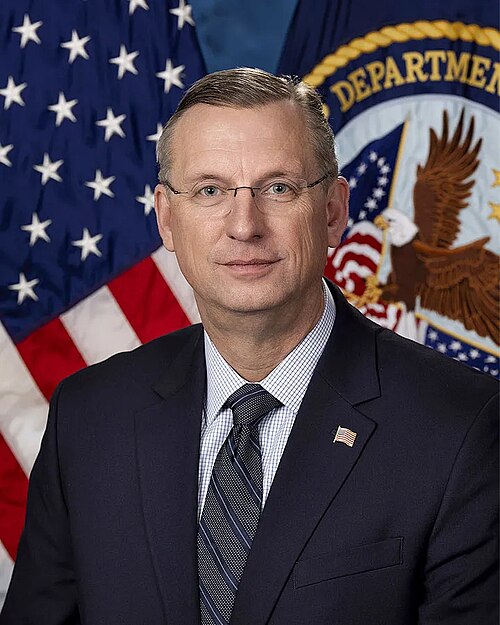
Douglas Allen Collins is a Georgia Republican who entered the Cabinet as the 12th United States Secretary of Veterans Affairs in February 2025. His public brand is not “quiet administrator.” It is confrontation with delay, bureaucracy, and anyone he believes is hiding behind process while veterans wait.
Collins is a veteran-facing politician with an unusually personal religious and military profile in the portfolio: he has served as a chaplain in the U.S. Air Force Reserve since 2002 and was promoted to colonel in 2023. He also deployed to Balad Air Base in Iraq for five months in 2008. That background shows up in how he talks about VA: as moral obligation, not just service delivery.
Before the Cabinet, Collins served in the Georgia House of Representatives from 2007 to 2013 (representing the 27th district—Hall, Lumpkin, and White County areas) and then in Congress as the U.S. representative for Georgia’s 9th district from 2013 to 2021. He left the House to run in Georgia’s 2020 special U.S. Senate election, finished third behind Raphael Warnock and Kelly Loeffler, and then stepped away from elected office.
After leaving Congress, he served as legal counsel for Donald Trump and became a high-trust political ally. Trump announced his intent to nominate Collins on November 14, 2024. Collins was confirmed on February 4, 2025 by a 77–23 vote and took office the next day.
As VA Secretary, Collins’ posture is “speed and accountability.” He frames appointment delays and claims backlogs as a form of abandonment. His critics argue that his approach can become media-forward disruption—especially when reforms intersect with staffing cuts, privatization concerns, and the operational reality of running the largest integrated health care system in the country.
Right-Wing Populist
Achievements
- Built a durable political brand around veterans’ access and claims accountability, translating “respect” into operational pressure on the VA system.
- Brings a chaplain-and-lawyer profile that frames veteran care as moral obligation plus casework execution, not abstract program design.
- Entered the Cabinet with real legislative experience: Georgia House leadership roles, then eight years in Congress, including high-salience oversight work.
- Uses blunt public messaging to keep backlogs, wait times, and transition gaps (active duty → VA) politically salient and hard to bury.
- Emphasizes rapid access pathways and “get seen now” logic that prioritizes speed over institutional pride.
Controversies
- Critics argue “faster access” can become a pipeline shifting VA care dollars outward and weakening the integrated system over time.
- Supporters see urgency; opponents say the combat style can demoralize career staff and reduce retention.
- His tenure is associated with major staffing-cut headlines (including an announced 72,000 job termination plan in March 2025), raising concerns about capacity and continuity.
- Democrats point to his role as a Trump-aligned political fighter and question neutrality in agency stewardship.
- Public pressure can accelerate fixes, but can also convert internal operations into perpetual headline conflict.
Senate Confirmation Vote
Votes For
Votes Against