
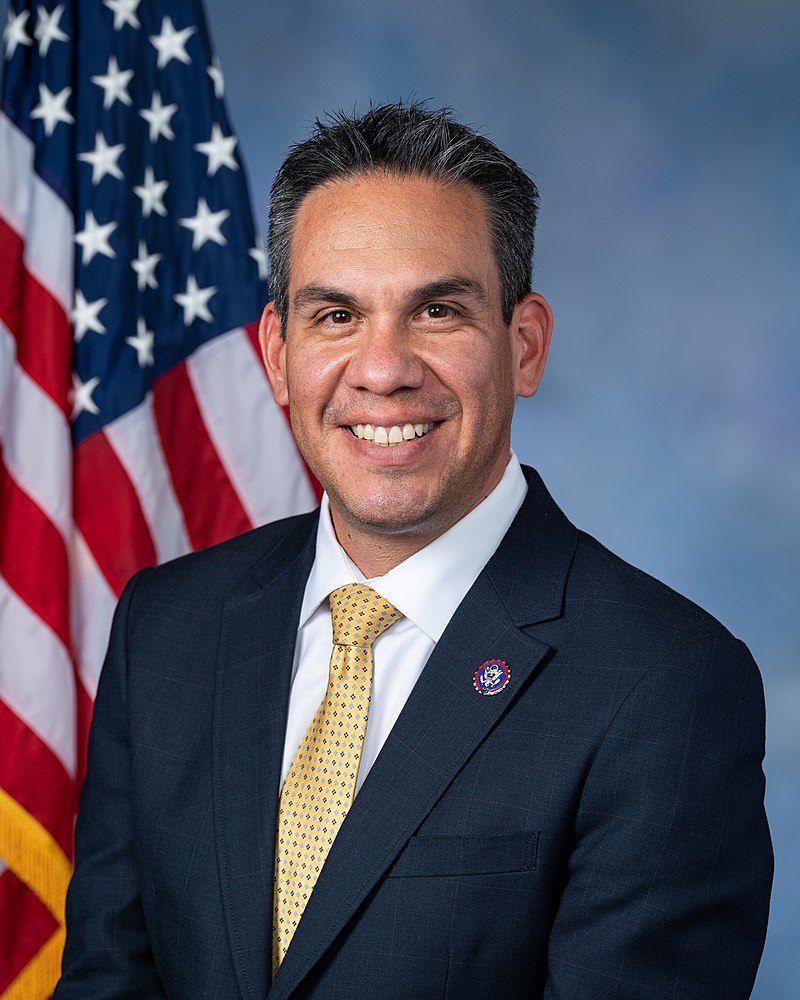
Peter Rey Aguilar is an American politician serving as the U.S. Representative for California's 33rd Congressional District since 2015 and as chair of the House Democratic Caucus since 2023, making him the highest-ranking Latino in Congress. Born on June 19, 1979, in Fontana and raised in a working-class family in San Bernardino, Aguilar is of Mexican descent and graduated from the University of Redlands, where he studied government and business administration. He began his public service career in 2001 when then-Governor Gray Davis appointed him deputy director of the Inland Empire Regional Office of the Governor, eventually becoming interim director.
In 2006, Aguilar became the youngest member of the Redlands City Council in the city's history after being selected from 11 candidates by five council members across party lines to fill an open seat. His fellow council members appointed him mayor in 2010 and again in 2012. As mayor, he was recognized for balancing the city budget during difficult financial conditions while building financial reserves, improving roads, and maintaining fair treatment of municipal employees. He served as president of the Inland Empire Division of the League of California Cities before running for Congress. He first ran for the 31st congressional district in 2012, finishing as the top Democratic vote-getter but being shut out of the November ballot when two Republicans advanced through the top-two primary. He ran again in 2014 and won the seat with 51.4 percent, defeating Republican Paul Chabot.
In Congress, Aguilar serves on the Committee on Appropriations, assigned to the Subcommittees on Defense and Transportation, Housing and Urban Development, and Related Agencies, a dual assignment that connects to the Inland Empire's significant military presence and its transportation infrastructure needs as one of the fastest-growing metropolitan regions in California. He led one of the January 6 Select Committee's most high-profile televised hearings in June 2022, focused on President Trump's pressure campaign on Vice President Pence. He was elected vice chair of the House Democratic Caucus in 2020 and chair in 2022, ascending to the third-ranking position in House Democratic leadership.
Aguilar's legislative record spans immigration reform, including co-authoring with Representative Will Hurd bipartisan legislation providing a citizenship path for DACA recipients, job creation initiatives connecting veterans and students of color with Defense Department cybersecurity programs, gun violence prevention including participation in the 2016 House floor sit-in, and securing recovery funding for the Inland Empire communities affected by the 2015 San Bernardino attack that occurred within his district. He has a broad caucus footprint spanning the New Democrat Coalition, Congressional Hispanic Caucus, Climate Solutions Caucus, and more than a dozen additional member organizations.
Moderate Democrat
Committee Assignments
Caucus Memberships
Achievements
- Elected chair of the House Democratic Caucus in 2022 for the 118th Congress, becoming the highest-ranking Latino in congressional history at the time, a position that places him as the third-ranking member of House Democratic leadership responsible for messaging strategy, member coordination, and serving as one of the party's most visible public spokespersons in the chamber, a role he has continued into the 119th Congress.
- Led one of the January 6 Select Committee's most consequential televised hearings on June 16, 2022, presenting evidence of President Trump's pressure campaign on Vice President Pence with witnesses including Pence's counsel Greg Jacob and retired Fourth Circuit judge J. Michael Luttig, whose characterization of Trump and his allies as a clear and present danger to American democracy generated significant national coverage and became one of the hearing's most cited moments.
- Co-authored bipartisan legislation with Republican Representative Will Hurd in 2018 that would provide a path to citizenship for DACA recipients while addressing border security concerns, one of the more substantive cross-party immigration agreements reached in the House during that Congress, reflecting Aguilar's positioning as a centrist negotiator on an issue of direct significance to his majority-Latino Inland Empire district.
- Secured passage of the ADVANCE Act and the OPPORTUNITY Act, both signed into law by President Trump in 2018, the former providing active-duty service members and reservists access to commercial driver's license training, and the latter connecting students of color with the Department of Defense Cyber Scholarship program, representing rare bipartisan legislative wins during a period of significant partisan gridlock.
- Secured recovery funding and federal cost reimbursements for Inland Empire communities following the 2015 San Bernardino attack, which occurred within his district, working with law enforcement and local, state, and federal agencies to ensure that emergency response costs were covered and that attack survivors received additional federal support, demonstrating constituent service on one of the most traumatic events in his district's history.
Controversies
- Aguilar was one of 16 House Democrats to vote against the Merger Filing Fee Modernization Act of 2022, an antitrust package designed to crack down on anti-competitive corporate behavior, a vote that drew criticism from progressive members and antitrust reform advocates who argued it placed him on the side of major corporate interests on one of the session's most significant competition policy measures, and that raised questions about his independence from the finance and defense industry donors that dominate his top contributor list.
- AIPAC is Aguilar's single largest career donor by a substantial margin at over $620,000, a funding total that far exceeds his next largest contributors and that has drawn sustained scrutiny from progressive and pro-Palestinian advocacy groups who argue it creates structural pressure toward uncritical alignment with AIPAC priorities on U.S. military aid to Israel, particularly given his vote to provide Israel with support following the October 7, 2023 Hamas attack and the subsequent debate over conditions on arms transfers during the Gaza war.
- In 2015, Aguilar voted for legislation that would effectively halt the resettlement of Syrian and Iraqi refugees to the United States, citing national security concerns, a vote he subsequently appeared to distance himself from when he criticized President Trump's travel ban executive order as xenophobic in 2017, a sequence that critics argued reflected political positioning rather than principled consistency on immigration and refugee policy.
- As House Democratic Caucus chair, Aguilar has navigated persistent intraparty tension between the progressive wing, which has at times pushed for more aggressive opposition tactics and policy demands on must-pass legislation, and the centrist members whose districts require more measured positioning, a balancing act that has drawn criticism from both directions and that defines the central challenge of a leadership role responsible for maintaining cohesion across a caucus with wide ideological range.
Top Donors
| # | Donor | Total |
|---|---|---|
| 1 | American Israel Public Affairs Committee | $620,903 |
| 2 | Wells Fargo | $51,300 |
| 3 | General Atomics | $44,600 |
| 4 | JStreetPAC | $39,350 |
| 5 | DaVita Inc | $36,800 |
Aguilar's donor profile is defined above all by AIPAC, which has contributed over $620,000 across his career, a total that is roughly twelve times his next largest organizational donor and that places him among the most heavily AIPAC-supported members of the entire California delegation. The remaining four donors reflect distinct facets of his committee and leadership positioning: Wells Fargo represents the financial sector's interest in a member of House Democratic leadership with Appropriations seniority; General Atomics, a major defense and energy technology firm headquartered in San Diego with significant operations tied to the Defense Subcommittee's jurisdiction, reflects Aguilar's direct relevance to defense procurement decisions; JStreetPAC, the pro-Israel but two-state-solution advocacy organization, signals a more diplomatically nuanced strand of pro-Israel engagement alongside the larger AIPAC total; and DaVita Inc, a major dialysis and kidney care company, connects to the healthcare industry's interest in a member whose Appropriations role touches on healthcare funding through the Transportation and Housing subcommittee's broader jurisdiction. His total career contributions of approximately $8.2 million reflect his accumulated seniority and leadership profile rather than marginal-district defense spending, since CA-33 is not a competitive seat.
Recent Elections
2018 General Election (CA-31)
Won D +17.4%| Candidate | Results | |
|---|---|---|
| Votes | % | |
| [D]Pete Aguilar (incumbent)✓ Winner | 110,143 | 58.7% |
| [R]Sean Flynn | 77,352 | 41.3% |
Aguilar won his third term by 17.4 points against Republican Sean Flynn, a noted result given that Flynn had nearly forced Aguilar into a same-party general election by finishing within half a point of him in the top-two primary at 45.5 percent to Aguilar's 45.9 percent, with a third Democratic candidate absorbing the remaining vote. The general election result was comfortable despite the primary scare, reflecting the district's D+5 Cook PVI lean and Aguilar's consolidation of Democratic support once the party-versus-party format was restored.
2020 General Election (CA-31)
Won D +22.6%| Candidate | Results | |
|---|---|---|
| Votes | % | |
| [D]Pete Aguilar (incumbent)✓ Winner | 175,315 | 61.3% |
| [R]Agnes Gibboney | 110,735 | 38.7% |
Aguilar won his fourth term by 22.6 points against Republican Agnes Gibboney in a presidential year that brought expanded turnout across the Inland Empire. The result was his strongest margin to that point and followed his election as vice chair of the House Democratic Caucus, reflecting the internal party recognition that accompanied his growing seniority and his profile as one of the most visible Latino members of the California delegation.
2022 General Election (CA-33)
Won D +15.4%| Candidate | Results | |
|---|---|---|
| Votes | % | |
| [D]Pete Aguilar (incumbent)✓ Winner | 76,588 | 57.7% |
| [R]John Mark Porter | 56,119 | 42.3% |
Aguilar won his fifth term by 15.4 points against Republican John Mark Porter after being redistricted from the 31st to the 33rd district following the post-census cycle. He was simultaneously elected chair of the House Democratic Caucus, becoming the highest-ranking Latino in congressional history at the time. The district's geographic core remained anchored in Redlands and the Inland Empire communities he had represented since 2015, and the result confirmed the seat's structural Democratic lean despite the renumbering.
2024 General Election (CA-33)
Won D +14.8%| Candidate | Results | |
|---|---|---|
| Votes | % | |
| [D]Pete Aguilar (incumbent)✓ Winner | 81,595 | 57.4% |
| [R]Tom Herman | 60,495 | 42.6% |
Aguilar won his sixth term by 14.8 points against Republican Tom Herman, a local real estate investor, holding his margin essentially steady from 2022 in a presidential year that produced mixed results for Democrats in Inland Empire-adjacent districts. He continued in his role as House Democratic Caucus chair, the highest-ranking leadership position he has held, and his Appropriations Committee seat on the Defense and Transportation subcommittees remained his principal legislative platform.
CA-33 covers the western San Bernardino County Inland Empire, anchored in Redlands and including Ontario, Fontana, Rialto, Colton, and surrounding communities. The district was previously numbered the 31st before the post-2020 census redistricting cycle. It is rated D+5 by the Cook Partisan Voting Index and has been consistently Democratic territory since Aguilar first won the seat in 2014, though it required competitive campaigning in his first two cycles before settling into a reliable Democratic hold. The Inland Empire's economy is anchored in logistics and warehousing, healthcare, light manufacturing, and public sector employment, with significant military presence from March Air Reserve Base and Norton Air Force Base. Aguilar's margins have ranged from 14.8 to 22.6 points across his four most recent general elections, reflecting a seat that is safe but not impregnable, and one that his accumulated seniority and leadership position now give him far more resources to defend than in his early competitive cycles.